



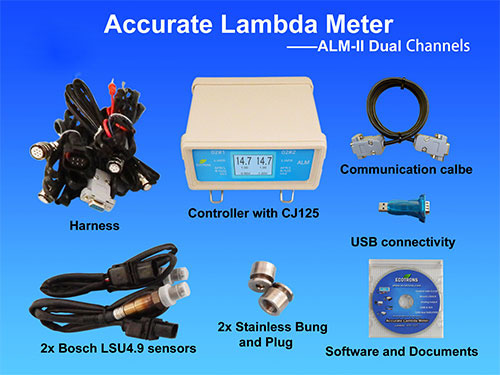
 ALM-II (Accurate Lambda Meter with Dual Channels)
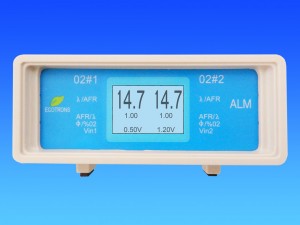
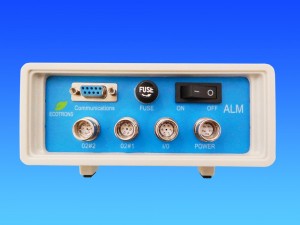
ALM-II (Accurate Lambda Meter with Dual Channels) is the dual-channel version of ALM. It includes 2x LSU 4.9 sensors, driven by Bosch CJ125 chips. It is typically used for V-shape engines, like V6, V8 or V10 engines, etc. It has all features of ALM, and more. It replaces ALM's LED display with a LCD and display more info: lambda or AFR, O2 concentrations in percentage (O2%), Analog inputs, etc.
All connectors are upgraded to the industry rated, and the housing is aluminum, and rugged. Real time measurement of O2 concentrations in the exhaust gas has become the new standard for a wideband controller. Only a few wideband controllers can do that. Again, ALM-II can measure a wider range of lambda, especially between 1.5 to 3.0 lambda range. That's the key area for diesel, gaseous fuel, flex fuel, dual fuel engines. Only a few wideband controllers can do that, again. Same as ALM, ALM-II uses Bosch LSU 4.9 sensors and CJ125 chips. LSU4.9 is the new generation wideband sensor evolving from LSU4.2. It is superior to LSU4.2 with the obvious proof: Bosch uses LSU4.9 across the board for their wideband applications. (appendix: LSU4.9 vs LSU4.2) Click here to see why LSU 4.9 is superior to 4.2 Besides air/fuel ratio measurement, ALM provides some supplemental functions which make your measurement or tuning more convenient: linear analog output to your ECU or gauge; LCD digital display; engine RPM probe, other analog sensor inputs like MAP and/or exhaust gas temperature (EGT); data logging with a serial communication to a PC, etc.The accuracy and response time are the most important characteristics of the lambda meter, or any metering device.To show the accuracy and the fast response of ALM, we compare the ALM analog output to the analog outs of INNOVATE's LC-1 and LM2, which are claimed to be the leaders of the aftermarket wideband controllers.
Click here for all news from variant customer applications
List of ALM parts ALM-II controller Harness (1.5 meter default, 3 meter optional) 2x Bosch LSU 4.9 sensor 2x Sensor plug and bung Serial communication cable USB to serial converter (optional, not included) CD - documents and ALM GUI software
ALM technical specifications Power supply Input voltage range: DC 9V~15 V (12V Typical) Input current: 50mA typical plus the heater current Polarity protection : Reverse polarity protected Load Dump Clamp : Maximum voltage Sensors Compatible: LSU4.9 Number of Sensors: dual LSU sensors optional) Free air calibration: Not necessary Measurement Lambda range: λ = 0.65 ~ ∞ Lambda accuracy: ±0.008 @ λ=1.00 ±0.01 @ λ=0.80 ±0.05 @ λ=1.70 Air/Fuel Ratio: Fuel dependent (see lambda range and accuracy) O2 consentration in %: critical for lean burn engines and gaseous engines, etc Response time 5ms sampling rate Heater Control built-in PID control with CJ125 Current Typical 1A; Max 1.5A Heater return (H-) Separate wire from Ground Output Lambda analog output: 0~5V user programmable Analog accuracy: ±0.005V error with a 10-bit DAC chip Analog type: Reference ground to ECU Narrow band O2 sensor simulated output (user programmable) Input RPM input: Ignition pick-up Analog input: MAP sensor optional Analog input: EGT (exhaust gas temperature) sensor optional Communications RS232 or USB (via a converter) User-friendly PC software for data acquisitions and analysis Display Low cost LED digital display Optional wideband gauge (52mm) Main-Processor CPU: Freescale MC9S12P128 16-bit Speed: 32MHz Memory: 128k Flash, 6k Ram, 4k Data Load Dump Clamp Maximum voltage Special features On-Board-Diagnosis and error report Self-learning of part-to-part variations, aging effect Working with different types of fuels (gasoline, diesel, E85, etc) General Temperature range: -30C ~ 125C Connector: multi-connectors, auto industry rated Dimensions: 200mm X 120mm X 80mm Wideband ALM-II Manual - v2.3
  ALM Serial Communication Protocol - SCI / RS232 / RS485 - v1.6
ALM GUI User Manual - v1.3
software
ALM GUI Setup - v2.9.16
ALM Serial Communication Protocol - SCI / RS232 / RS485 - v1.6
ALM GUI User Manual - v1.3
software
ALM GUI Setup - v2.9.16
| Characteristics | LSU4.2 | LSU4.9 | Notes |
| lambda range | lambda = 0.65 ~ ∞ | lambda = 0.65 ~ ∞ | |
| Accuracy | only good at lambda = 1 or moderate rich | accurate at both rich and lean, wider range | LSU4.2 is only accuracy at lambda ≈1 and moderate rich, between 0.8~1.0 lambda; LSU4.9 has better accuracy in both rich and lean conditions, suitable for gasoline, diesel, CNG, etc. |
| Response time | Slower | Faster | Thinner sensing element of LSU 4.9 makes it more responsive to the AFR change, dynamically more accurate, and easier to light off, less heating power needed. |
| Heating power | 10W | 7.5W | LSU4.2 has the off-centered-heater vs. LSU 4.9 has the centered-heater in the laminate; LSU4.9 has better heating efficiency, less heating power needed. |
| Free air calibrations | needed | not needed | LSU4.2 is susceptible to reference air contaminations, which is called CSD (characteristic shift down), requires frequent free-air calibrations. LSU4.9 uses reference pump current instead of reference air. No more CSD. No requirement of free-air calibrations |
| Nernst cell resistance vs. temperature | 80~750C | 300~790C | LSU4.9 has higher resolution of internal resistance vs. temperature characteristics, which makes the temperature measurement more accurate, and better heater control, therefore higher accuracy of lambda. |
| Light off time | long | short | LSU4.9 lights off faster. Lambda controls can be active much faster during warm up phase. |
| Reliability | Improved reliability | LSU4.9 is superior to LSU4.2 with regard to the reliability and life. | |
| Check with Bosch | Still selling it | Recommended | Bosch recommends LSU4.9 to all OEMs. Bosch uses LSU4.9 for its own wideband controller. http://www.bosch-motorsport.de/media/catalog_resources/Lambdatronic_LT4_Datasheet_51_en_2785631627pdf.pdf |


