



What is an in-line fuel pump?
An external electric pump installed directly in the fuel hose between the tank and the engine.
What is a small fuel pump?
A compact, low-flow pump designed around the pressure, power, weight and packaging limits of small engines.
What is UAV EFI?
An electronic fuel-injection system optimized for aircraft engines where altitude, reliability, power draw and weight matter.
What is a wideband O₂ sensor?
A heated exhaust sensor and controller that measure lambda across a broad rich-to-lean range.
Fuel Delivery
What is an in-line fuel pump?
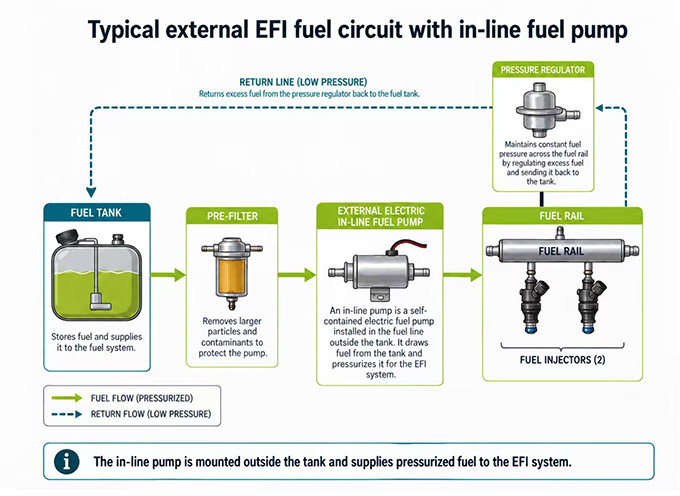
An in-line fuel pump is installed in the fuel line, normally outside the fuel tank. Its inlet connects to the tank, and its outlet supplies pressurized fuel to the injector, fuel rail or pressure regulator.
Unlike an in-tank pump, an in-line pump is easier to access and can be practical for EFI conversions, prototypes, motorcycles, generators, UAV test systems and other installations where modifying the fuel tank is undesirable.
External installation: mounted along the fuel hose, not submerged in the tank.
Pressurized supply: provides the pressure needed for stable injector flow.
Serviceable layout: generally easier to inspect, replace and reconfigure.
Important: inlet restriction, mounting orientation, filtration and heat exposure must follow pump requirements.
Compact EFI Hardware
What is a small fuel pump?
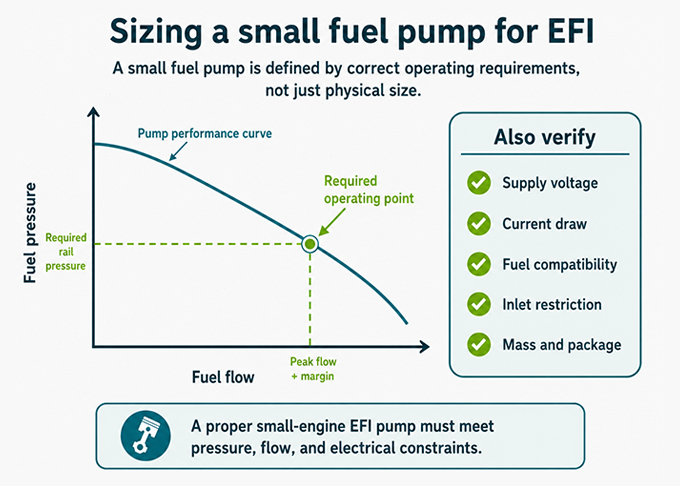
“Small fuel pump” is a functional description rather than one universal pump type. It usually means a pump selected for a small-displacement engine or a system with strict limits on size, weight, current draw and fuel flow.
A properly sized pump must provide enough flow at the required pressure, with margin for peak engine demand. An oversized automotive pump may waste electrical power, heat the fuel, complicate pressure control and add unnecessary weight.
| Design factor | Why it matters |
|---|---|
| Flow rate | Must exceed maximum engine fuel consumption at operating pressure. |
| Fuel pressure | Must match the injector and pressure-regulator strategy. |
| Current draw | Critical for UAVs, motorcycles and small charging systems. |
| Fuel compatibility | Pump materials must suit gasoline, ethanol blends or the intended fuel. |
| Self-priming / lift | Important when the pump sits above or away from the tank outlet. |
UAV Engine Management
What is UAV EFI?
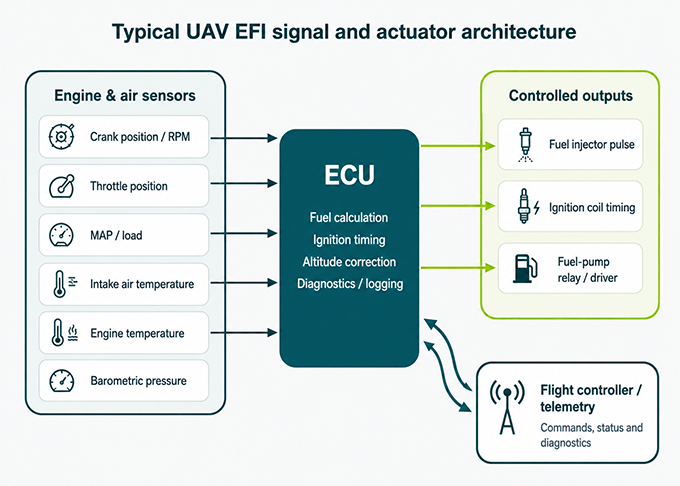
UAV EFI is an electronic fuel-injection system adapted for piston engines used in Unmanned Aerial Vehicles. It replaces or supplements a carburetor with electronically controlled fuel metering.
The ECU calculates injection quantity from engine speed, throttle demand and sensor data. Depending on the system, it may also control ignition, throttle servo functions, diagnostics and communication with the UAV controller.
Why EFI matters for UAVs
Altitude compensation: barometric and manifold-pressure inputs help correct fueling as air density changes.
Cold and hot starting: electronic enrichment can improve starting consistency.
Transient control: fueling can be adjusted during rapid throttle changes.
System integration: CAN or other interfaces can expose operating data and diagnostics.
Exhaust Feedback
What is a wideband O₂ sensor?
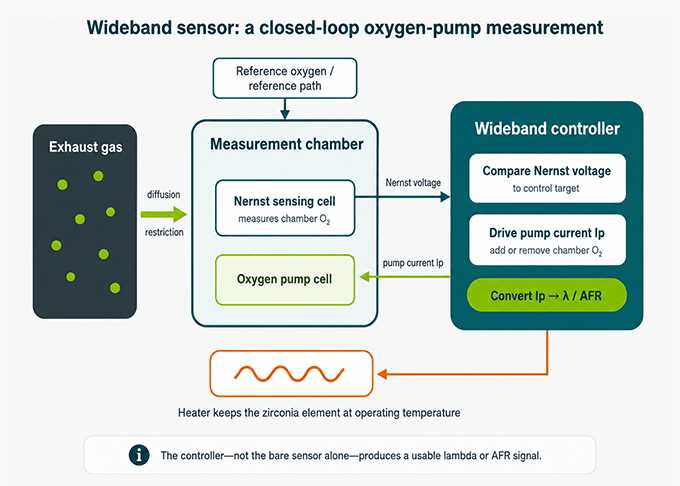
A wideband oxygen sensor, also called a wideband lambda sensor, measures residual oxygen in exhaust gas so the air-fuel ratio can be determined over a broad rich-to-lean range. Lambda compares the actual air-fuel ratio with the stoichiometric ratio for the fuel. λ = 1 is stoichiometric, λ < 1 is rich, and λ> 1 is lean. Unlike a conventional narrowband sensor, a wideband sensor provides accurate mixture information well away from λ = 1.
What does ALM do with it?
The ALM works with the wideband O₂ sensor to form a complete air-fuel ratio measurement system. It controls the sensor heater and pump cell, processes the sensor signals, and converts them into real-time lambda, AFR, or oxygen concentration data for monitoring, calibration, or ECU control.
- Heat the sensor – An integrated heater brings the zirconia element to its controlled operating temperature.
- Sample exhaust – Exhaust gas diffuses into a small measurement chamber in the sensing element.
- Pump oxygen – The controller drives a pump cell to add or remove oxygen and hold the sensing cell near its reference condition.
- Calculate lambda – The magnitude and direction of pump current are mapped to lambda, AFR or oxygen concentration.
Frequently Asked Questions
EFI Wiki FAQ
Is an in-line fuel pump the same as an in-tank fuel pump?
No. An in-line pump is installed externally in the fuel line. An in-tank pump is submerged in fuel inside the tank. Either layout can support EFI when the pump, filtration, pressure regulation and installation are correctly engineered.
Can a fuel pump be too large for a small engine?
Yes. Excess capacity can increase current draw, fuel heating, noise and pressure-regulator bypass flow. Pump selection should use required pressure and peak fuel demand rather than engine displacement alone.
Why is EFI useful for UAV engines?
EFI enables programmable fuel control, altitude compensation, starting enrichment, transient compensation and diagnostics. The real benefit depends on calibration quality and the reliability of the complete installation.
Does a wideband O₂ sensor connect directly to a basic analog input?
Usually not. Bosch LSU-type sensors require a dedicated wideband controller or sensor-interface circuit to regulate the heater and pump cell. The controller then provides lambda information through analog voltage, CAN, serial communication or another supported output.