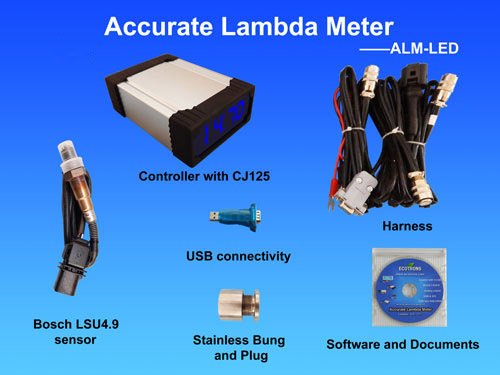
 ALM LSU 4.9
( This picture is only for ALM-LED package, other packages like ALM-CAN, ALM-Board, are also available.)
ALM LSU 4.9
( This picture is only for ALM-LED package, other packages like ALM-CAN, ALM-Board, are also available.)
While many wideband controller manufacturers are still using the LSU4.2 sensors for their flagship products, EcoEFI ALM took the lead to move to the LSU4.9 sensor. The key difference that LSU 4.9 gets rid of is the air reference, which is the biggest failure mode, instead of that, a reference pumping current was introduced. As a result, LSU 4.9 has a long life and can maintain accuracy throughout life. Only since then, Bosch LSU sensors have been used widely in the auto industries. For more detailed information, please refer to Bosch LSU 4.9 is superior to LSU 4.2 sensors | News | EcoEFI
The highlights of new LSU 4.9 sensors: Thinner sensing element. LSU 4.2 is 1.5mm, while LSU 4.9 is only half of that. More accurate measurements and faster response. New design of protection tubes. Has a new design of the inner tube since sensing element is protected by a double layer tube. Improved gas flow, faster dynamic response. Significantly reduced thermal shock risk. Measuring the internal resistance and close loop control of the sensor temperature This is done with the CJ125 chip. By controlling the sensor temperature in the close-loop mode, can make the LSU sensor accurate. This is the fundamental difference between the LSU 4.2 and LSU 4.9.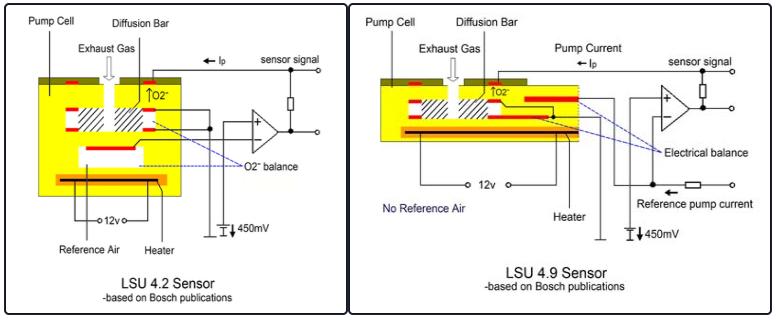 List of ALM-LSU 4.9 parts
Rugged ALM controller
built-in LED display (or other packages, contact us for details)
Harness (1.5 meter default, 3 meter optional)
Bosch LSU 4.9 sensor
Sensor plug and bung
Serial communication + USB adapter, Or
CAN bus optional
CD - documents and ALM GUI software
ALM technical specifications
Power supply
Input voltage range: DC 9V~15 V(12V Typical)
Input current: 50mA typical plus the heater current
Voltage protection: Reverse polarity protected, & overvoltage protected
Load Dump Clamp: Maximum voltage
Sensors
Compatible: LSU 4.9
Number of Sensors: One
Free air calibration: automatic calibration available
Measurement
Lambda range: λ = 0.65 ~ ∞
Lambda accuracy: ±0.007 @ λ=1.00
±0.01 @ λ=0.80
±0.05 @ λ=1.70
Air/Fuel Ratio: Fuel dependent (see lambda range and accuracy)
Response time
10ms updating rate (everything finished in 10ms)
Heater
Control built-in PID control with CJ125
Current Typical 1A; Max 1.5A
Heater return (H-) Separate wire from Ground
Output
Lambda analog output: 0~5V user programmable
Analog accuracy: ±0.005V error with a 10-bit DAC chip
Analog type: Reference ground to ECU
second Lambda analog output: 0~5V for a third party gauge, user programmable
Communications
advanced CAN bus communication (optional)
RS232 or USB (via an adaptor) for logging or programming
User-friendly PC software for data acquisitions and analysis
Display
4 digit LED display
including 2 digit floating numbers
AFR, lambda, O2% configurable
Main-Processor
CPU: FreeScale 16-bit micro-processor S12P (auto industry rated)
Speed: 32MHz
Memory: 128k Flash, 6k Ram, 4k Data
Load Dump Clamp
Maximum voltage
Special features
On-Board-Diagnosis and error report
Self-learning of part-to-part variations, aging effect
Working with different types of fuels (gasoline, diesel, E85, etc)
General
Temperature range: -45C ~ +125 C (can be installed in the engine compartment)
Dimensions: 4" x 2.6" x 1"
List of ALM-LSU 4.9 parts
Rugged ALM controller
built-in LED display (or other packages, contact us for details)
Harness (1.5 meter default, 3 meter optional)
Bosch LSU 4.9 sensor
Sensor plug and bung
Serial communication + USB adapter, Or
CAN bus optional
CD - documents and ALM GUI software
ALM technical specifications
Power supply
Input voltage range: DC 9V~15 V(12V Typical)
Input current: 50mA typical plus the heater current
Voltage protection: Reverse polarity protected, & overvoltage protected
Load Dump Clamp: Maximum voltage
Sensors
Compatible: LSU 4.9
Number of Sensors: One
Free air calibration: automatic calibration available
Measurement
Lambda range: λ = 0.65 ~ ∞
Lambda accuracy: ±0.007 @ λ=1.00
±0.01 @ λ=0.80
±0.05 @ λ=1.70
Air/Fuel Ratio: Fuel dependent (see lambda range and accuracy)
Response time
10ms updating rate (everything finished in 10ms)
Heater
Control built-in PID control with CJ125
Current Typical 1A; Max 1.5A
Heater return (H-) Separate wire from Ground
Output
Lambda analog output: 0~5V user programmable
Analog accuracy: ±0.005V error with a 10-bit DAC chip
Analog type: Reference ground to ECU
second Lambda analog output: 0~5V for a third party gauge, user programmable
Communications
advanced CAN bus communication (optional)
RS232 or USB (via an adaptor) for logging or programming
User-friendly PC software for data acquisitions and analysis
Display
4 digit LED display
including 2 digit floating numbers
AFR, lambda, O2% configurable
Main-Processor
CPU: FreeScale 16-bit micro-processor S12P (auto industry rated)
Speed: 32MHz
Memory: 128k Flash, 6k Ram, 4k Data
Load Dump Clamp
Maximum voltage
Special features
On-Board-Diagnosis and error report
Self-learning of part-to-part variations, aging effect
Working with different types of fuels (gasoline, diesel, E85, etc)
General
Temperature range: -45C ~ +125 C (can be installed in the engine compartment)
Dimensions: 4" x 2.6" x 1"